
Aluminium Scaffold Tower Load Classes: EN 1004 Class 2 vs. Class 3 Procurement Guide
A 2026 procurement guide explaining EN 1004 load classes for aluminium scaffold towers. Compare Class 2 (1.5 kN/m²) vs. Class 3 (2.0 kN/m²) for safe purchasing.
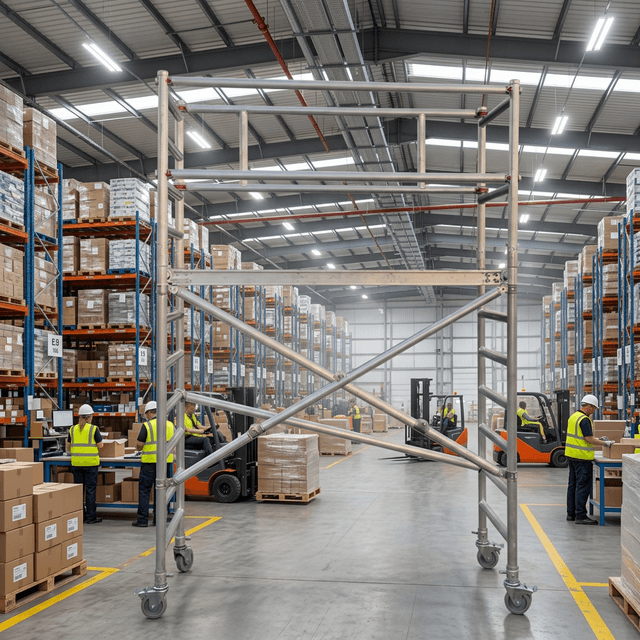
One-line buyer decision: When procuring aluminium scaffold towers, selecting between EN 1004 Class 2 and Class 3 is a critical structural decision—Class 3 (200 kg/m²) is mandatory for heavy-duty commercial trades, while Class 2 (150 kg/m²) is restricted to light inspection and maintenance tasks.
For procurement teams, fleet managers, and site engineers operating in 2026, purchasing aluminium scaffold towers requires more than just specifying the working height. With global safety authorities strictly enforcing the EN 1004-1:2020 standard, the most critical specification that dictates safety, compliance, and product lifespan is the Load Class.
Failing to align the scaffold's load class with the intended trade application is a primary cause of platform failure, accelerated equipment depreciation, and compliance breaches. This comprehensive guide breaks down the differences between Class 2 and Class 3 towers, providing a clear framework for procurement decisions.
Scope note for global buyers: This guide uses EN 1004-1:2020 as the technical benchmark for prefabricated mobile access towers, but it does not replace local inspection, training, height-limit, or employer-duty rules. Treat the manufacturer's certificate, tower label, user manual, and project risk assessment as the binding procurement record.
Preparing an RFQ? Ask suppliers to return the declared load class, platform UDL, maximum platform load, castor rating, assembly method, and certificate issuer in one technical schedule before price comparison. If you need a project-specific check, use the contact workflow with tower dimensions, intended trade, and loading assumptions.
1. Understanding EN 1004 Load Classes
The European standard EN 1004 (widely adopted globally as a benchmark for mobile access towers) classifies towers based on the maximum safe load the platform can support. This is measured as a Uniformly Distributed Load (UDL), meaning the weight must be spread evenly across the platform surface, rather than concentrated in one spot.
What happened to Class 1?
It is a common misconception among buyers to look for a "Class 1" tower for basic use. Under EN 1004, there is no Class 1 for mobile access towers. The baseline for certified mobile towers begins at Class 2.
Class 2: The Light-Duty Standard
- Load Capacity: 1.5 kN/m² (approximately 150 kg per square meter).
- Typical Total Platform Load: For a standard 1.8m x 0.7m single-width tower, the maximum total load is generally around 150 kg to 180 kg (depending on exact dimensions and manufacturer specs).
- Application: Strictly light-duty. Designed for one worker with minimal hand tools.
Class 3: The Heavy-Duty Standard
- Load Capacity: 2.0 kN/m² (approximately 200 kg per square meter).
- Typical Total Platform Load: For a standard 2.5m x 1.4m double-width tower, the maximum total load can range from 500 kg to 700 kg (minus the weight of the tower itself, always refer to manufacturer tags).
- Application: Heavy commercial and industrial use. Designed for multiple workers, heavy materials (e.g., brickwork, large glazing units, HVAC components), and continuous site abuse.
2. Application Boundaries: When to Spec Which Class?
Procurement errors usually occur when buyers prioritize initial capital expenditure (CAPEX) over application suitability. Buying a Class 2 tower for a Class 3 application is a severe safety hazard.
Where Class 2 is Sufficient
- Facilities Management & Cleaning: Changing light fixtures, cleaning windows, or inspecting drop ceilings.
- Light Electrical & Data Cabling: Running cables where the operator only needs hand tools and wire spools.
- Painting & Decorating: Simple residential or light commercial painting tasks.
Where Class 3 is Mandatory
- Commercial Construction & Bricklaying: Loading blocks, mortar tubs, and heavy masonry tools.
- HVAC & Plastering: Lifting heavy air conditioning units, ductwork, or large quantities of plasterboard.
- Demolition & Heavy Refurbishment: Scenarios where unpredictable point loads may occur, or where debris might be temporarily rested on the platform.
- Rental Fleets: Hire companies should exclusively procure Class 3 towers, as they cannot control how the end-user will load the equipment.
3. Structural Differences & Total Cost of Ownership (TCO)
The difference in load capacity is not arbitrary; it is engineered into the physical properties of the aluminium scaffold tower.
- Extrusion Wall Thickness: Class 3 towers typically utilize high-grade aluminium alloy (such as 6061-T6) with a wall thickness of 1.8mm to 2.0mm. Class 2 towers may use thinner extrusions (1.2mm to 1.6mm) to save costs and weight.
- Platform Decking: Class 3 platforms are reinforced with additional structural profiles beneath the marine-grade plywood or aluminium deck to prevent sagging under concentrated loads.
- Castors and Base Plates: Class 3 towers require heavy-duty, dual-locking castors (often polyurethane coated) rated for higher individual load limits (e.g., 600kg+ per castor) to transfer the platform weight safely to the ground.
While a Class 2 tower might be 15% to 30% cheaper to procure initially, a Class 3 tower offers a significantly better Total Cost of Ownership (TCO) for construction firms. Thicker extrusions resist denting from site abuse, the reinforced platforms last longer before needing replacement, and the versatile load rating means the tower can be deployed across a wider range of high-margin heavy projects.
4. Feature Comparison: Class 2 vs. Class 3 Procurement
| Specification Feature | Class 2 Aluminium Tower | Class 3 Aluminium Tower | Procurement Implication |
|---|---|---|---|
| Max UDL | 1.5 kN/m² (150 kg/m²) | 2.0 kN/m² (200 kg/m²) | Class 3 allows for materials + workers; Class 2 is generally workers only. |
| Typical Wall Thickness | 1.2mm - 1.6mm | 1.8mm - 2.0mm+ | Thicker walls in Class 3 drastically reduce replacement costs due to transit damage. |
| Primary Use Case | Light maintenance, DIY, low-level | Commercial construction, rental fleets | Match the class to your trade. Under-speccing creates massive liability. |
| System Weight | Lighter (easier single-person transport) | Heavier (requires robust logistics) | Class 2 is easier to move in vans; Class 3 provides maximum stability. |
| Compliance Standard | EN 1004-1:2020 | EN 1004-1:2020 | Both must be fully certified to the latest standard. |
| Castor Wheel Specs | Single-lock, lighter capacity | Dual-lock polyurethane, 600kg+ capacity | Insist on heavy-duty, dual-lock castors for Class 3 high-load applications. |
| Upfront Cost (CAPEX) | Lower ($) | Higher ($$) | Class 3 has higher CAPEX but superior TCO for professional contractors. |
5. The 2026 Procurement Checklist for Aluminium Towers
Before issuing a Purchase Order (PO) for new scaffolding fleet inventory, run through this critical checklist to ensure compliance and commercial viability:
- Verify the Load Class Rating: Does the manufacturer clearly state whether the tower is Class 2 or Class 3 on the data plate and documentation?
- Request EN 1004-1:2020 Certification: Do not accept "EN 1004:2004" certificates. Ensure the test reports are from a recognized third-party laboratory (e.g., TUV, BSI).
- Audit the Extrusion Specs: Ask the supplier for the exact alloy grade (e.g., 6082-T6) and minimum wall thickness. Reject anything below 1.6mm for commercial use.
- Check Point Load Limits: Ask about the maximum point load capacity of the platform deck, not just the UDL. This matters if workers rest heavy toolboxes in the center of the board.
- Assess the Assembly Method: Ensure the tower utilizes compliant fall-protection erection methods during the assembly of scaffolding—either 3T (Through The Trapdoor) or AGR (Advance Guard Rail).
- Review Castor Certification: Ensure the castors are individually load-rated to support the fully loaded tower weight plus a safety factor.
6. Risks of Non-Compliance and Overloading
Procurement departments must understand that selecting an inadequate load class shifts the liability onto the employer.
If a Class 2 tower is overloaded with brickwork, the initial failure point is rarely a catastrophic collapse of the vertical frames. Instead, the failure usually begins with platform deflection (the deck bows), causing the hooks to warp and detach from the horizontal transoms. Once the deck fails, the entire structural integrity of the tower is compromised, leading to severe falls.
Health and Safety authorities globally (including HSE in the UK and OSHA equivalents) explicitly check scaffold load tags during site inspections. Using a Class 2 tower for heavy masonry work will result in immediate prohibition notices and potential fines.
7. Strategic Sourcing: Partnering for Safety
Procuring aluminium scaffold towers should be viewed as a strategic safety partnership. Do not buy on price alone from generic online marketplaces. Look for manufacturers who provide:
- Transparent engineering data and material specifications.
- Full traceability and serialized batch testing.
- Long-term spare parts availability to extend the TCO of your Class 3 investment.
If your project demands rigorous compliance, high load capacities, and uncompromising structural integrity, ensure your next RFQ explicitly specifies EN 1004-1:2020 Class 3 Aluminium Scaffold Towers.
Need help specifying the right load class for your next project? Our engineering team can assist you in selecting the compliant, heavy-duty aluminium scaffold systems tailored for your site requirements. Contact our procurement specialists today to request full load capacity documentation and technical specifications.
References & Sources
- PASMA (Prefabricated Access Suppliers' and Manufacturers' Association): Guidance on the EN 1004 revision and mobile access tower requirements. https://pasma.co.uk/faqs/en-1004-revision/en-1004-complete-guide/
- EN 1004-1:2020 Standard: Mobile access and working towers made of prefabricated elements – Part 1: Materials, dimensions, design loads, safety and performance requirements. https://knowledge.bsigroup.com/products/mobile-access-and-working-towers-made-of-prefabricated-elements-materials-dimensions-design-loads-safety-and-performance-requirements-1/standard
- HSE (Health and Safety Executive): Tower scaffolds safety guidelines and regulations. https://www.hse.gov.uk/construction/safetytopics/scaffold.htm
- OSHA (Occupational Safety and Health Administration): Scaffolding eTool and compliance guidelines. https://www.osha.gov/scaffolding