
Aluminium scaffold outriggers checker for aluminum scaffolding outriggers buyers
Buyers searching for scaffolding outriggers, aluminium scaffold outriggers, or aluminum scaffolding outriggers usually need immediate routing first, then evidence for approval. This page starts with a usable checker and keeps the report layer on the same URL for trust and traceability.
Tool layer solves the first decision. Report layer explains why the decision is credible, where it breaks, and what to do next. No duplicate alias route is created.
Alias jump link: aluminum scaffolding outriggers lands on this same canonical page and routes to the tool.
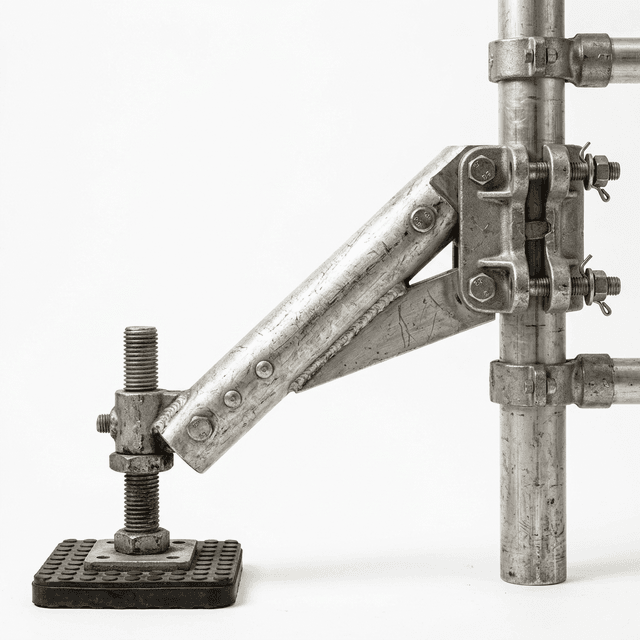
Complete support geometry
Visual reference for how outriggers extend stability envelope beyond the base frame footprint.
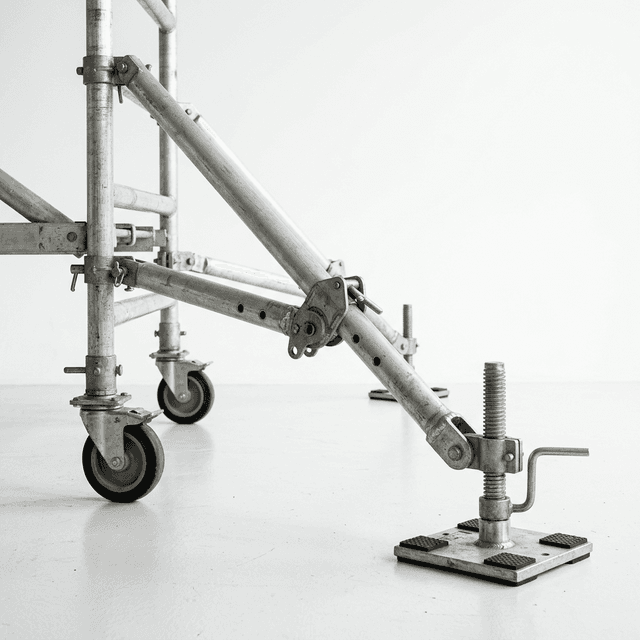
Stabilizer interface detail
Compatibility and locking details remain model-dependent even when keyword intent appears straightforward.
Core conclusions, key numbers, and who should not use this route
Alias intent is solved on one page: “scaffolding outriggers,” “aluminum scaffolding outriggers,” and “aluminium scaffold outriggers”
This page intentionally keeps tool, evidence, and CTA on one canonical route so buyers do not get conflicting decisions across near-duplicate URLs.
Sources: PASMA product-standard FAQ
Tool output is actionable and bounded, not just a label
The checker returns RFQ-ready, controlled, or manual-review results plus an explicit boundary statement and the next action path.
Sources: OSHA mobile scaffold eTool · HSE tower scaffold safety topic
Working-height-to-base ratio is a screening signal, not a legal approval value
The route uses ratio as an early warning system; trigger heights and outrigger configurations remain model- and market-specific.
Sources: HSE work-at-height FAQ · PASMA product-standard FAQ
Edge, void, and soft-fill scenarios must jump to manual review
Support ambiguity usually invalidates a routine accessory quote. The page explicitly marks this as non-routine to prevent unsafe procurement shortcuts.
Sources: OSHA 1926.451 general requirements · Safe Work Australia scaffold guide
Ridden movement expectation is treated as a boundary condition
When a brief assumes occupied movement, the page routes directly into manual compliance review before commercial quoting.
Sources: OSHA 1926.452 mobile scaffolds · OSHA mobile scaffold eTool · HSE tower scaffold safety topic
All key claims point to dated public sources
Each core claim in this page references source and check date, while unknowns are explicitly declared instead of guessed.
Sources: HSE tower scaffold safety topic · OSHA 1926.451 general requirements · OSHA 1926.452 mobile scaffolds · Safe Work Australia scaffold guide
Outdoor exposed scenarios escalate controls earlier
Wind exposure materially changes outriggers planning. This is reflected in checker routing and risk-table mitigation actions.
Sources: HSE tower scaffold safety topic · SafeWork NSW scaffold checklist
Early controlled-routing reduces procurement rework loops
A clearer first RFQ reduces email churn, avoids wrong-part ordering, and keeps compliance review synchronized with purchasing timelines.
Sources: PASMA product-standard FAQ · OSHA 1926.451 general requirements
Recent national injury data confirms this is not a low-stakes accessory decision
BLS reported 844 U.S. fatal falls/slips/trips in 2024 (370 in construction/extraction), while HSE reported 124 worker deaths in 2024/25 with falls from height still the leading cause. Route quality matters before price speed.
Sources: BLS CFOI summary 2024 · HSE fatal injuries overview (2024/25)
Best fit for this route
Controlled-fit cases
Not suitable for direct quote
How the tool output is produced and why the trust layer is auditable
The checker prioritizes deterministic routing with explicit uncertainty boundaries. Evidence is mapped so reviewers can inspect assumptions quickly.
Step 1 - Capture explicit geometry inputs
The checker forces platform height and base width inputs so the first output is grounded in declared geometry rather than keyword-only assumptions.
Step 2 - Evaluate support and movement context
Surface condition, movement plan, and wind exposure are assessed before market and procurement context, because these factors drive immediate safety routing.
Step 3 - Apply market-specific boundary notes
The result adds destination-market notes and avoids pretending one global scaffold-outrigger rule is sufficient for every jurisdiction.
Step 4 - Emit bounded route status
Output state is either RFQ-ready, controlled review, or manual review. Every state includes explicit next steps and a CTA.
Step 5 - Preserve trust via evidence table + risks
The report layer lists sources, known/unknown boundaries, and risk mitigations so commercial decisions remain auditable.
Step 6 - Separate regulation, guidance, and standard-version scope
The page labels which claims are enforceable regulation, which are guidance/checklist signals, and where standard-version drift or data gaps require explicit manual confirmation.
Source map checked on Jun 28, 2026
Each source includes usage note and review date so decision quality remains explainable.
HSE tower scaffold safety topic
Checked Jun 28, 2026
Official HSE guidance checked Jun 28, 2026. Used for foundation condition, recurring inspection cadence in construction use, and the no-movement-with-people baseline in normal operation planning.
Open sourceHSE work-at-height FAQ
Checked Jun 28, 2026
Official HSE FAQ checked Jun 28, 2026. Used for the rule that maximum tower height comes from manufacturer instruction rather than generic internet shortcuts.
Open sourceOSHA 1926.451 general requirements
Checked Jun 28, 2026
Official OSHA regulation checked Jun 28, 2026. Used for foundation integrity, 4x load baseline, and competent-person inspection requirement before each shift and after integrity-affecting events.
Open sourceOSHA 1926.452 mobile scaffolds
Checked Jun 28, 2026
Official OSHA regulation checked Jun 28, 2026. Used for locking while stationary, movement stabilization controls, and occupied movement limits tied to slope and ratio conditions.
Open sourceOSHA mobile scaffold eTool
Checked Jun 28, 2026
Official OSHA explainer checked Jun 28, 2026. Used for practical movement details: apply force low, control path quality, speed <= 1 ft/s for powered movement, and explicit outrigger mention in occupied movement context when used.
Open sourceSafe Work Australia scaffold guide
Checked Jun 28, 2026
Official Safe Work Australia guide (July 2014) checked Jun 28, 2026. Used for foundation/load planning, pre/post-use inspection baseline, and duty/licensing boundaries where trigger details still depend on current model documentation.
Open sourceSafe Work Australia tower/mobile scaffold info sheet
Checked Jun 28, 2026
Official information sheet (July 2014) checked Jun 28, 2026. Used for mobile movement baseline (no people/materials onboard), windy-condition restriction, and the adjustable-wheel slope cue (<= 5 degrees) as guidance-level signal.
Open sourceSafeWork NSW scaffold checklist
Checked Jun 28, 2026
Official SafeWork NSW checklist checked Jun 28, 2026. Used for site-level controls: hard/flat support, castor-lock discipline, guardrail baseline above 2 m, and recurring competent-person inspection cadence (not exceeding 30 days).
Open sourceHSE fatal injuries overview (2024/25)
Checked Jun 28, 2026
Official HSE statistics page checked Jun 28, 2026. Updated 2025-07-30: 124 worker deaths in 2024/25, with falls from height still the leading cause (over a quarter). Used for risk-priority calibration.
Open sourceBLS CFOI summary 2024
Checked Jun 28, 2026
Official BLS release checked Jun 28, 2026. Released 2026-02-19: 844 U.S. fatal falls/slips/trips in 2024, with 370 among construction and extraction workers. Used for current U.S. risk-burden context.
Open sourcePASMA product-standard FAQ
Checked Jun 28, 2026
PASMA FAQ checked Jun 28, 2026. Used for EN 1004-1:2020 and EN 1004-2:2021 version boundaries, plus withdrawal of older EN 1004:2004/EN 1298:1996 routes.
Open sourcePASMA safety FAQ: wind guidance
Checked Jun 28, 2026
Operational guidance checked Jun 28, 2026. Specifies a strict mobile-access-tower wind boundary: if average wind speed reaches 17 mph (Beaufort 4, 7.6 m/s), stop work and dismantle the tower.
Open sourcePASMA EN 1004 product-standard boundary
Checked Jun 28, 2026
Product-standard FAQ checked Jun 28, 2026. Used for current EN 1004-1:2020 / EN 1004-2:2021 scope and the note that tower scaffolds subject to wind loads above 0.1 kN/m² fall outside EN 1004-1 scope; exact outrigger layout still needs the current model manual.
Open sourceRoyal Society of Chemistry aluminium data
Checked Jun 28, 2026
Element data checked Jun 28, 2026. Used for aluminium density (2.70 g/cm³) and low-density material context, not for scaffold model approval.
Open sourceRoyal Society of Chemistry iron data
Checked Jun 28, 2026
Element data checked Jun 28, 2026. Used for iron density (7.87 g/cm³) as a transparent proxy comparison for steel-weight intuition, not for component-level design approval.
Open sourceCal/OSHA scaffolding rules
Checked Jun 28, 2026
California state regulations checked Jun 28, 2026. Used for stricter 3:1 stationary ratio and 1/2 height rolling base dimension rules, contrasting federal OSHA.
Open sourceEN 1004-1 height limits
Checked Jun 28, 2026
European standard limits checked Jun 28, 2026. Used to set the hard 8m outdoor and 12m indoor boundary where standard outrigger rules stop applying.
Open sourceHSE moving towers safely
Checked Jun 28, 2026
Safe working practices checked Jun 28, 2026. Used for strict rules on removing outriggers to pass doorways (must dismantle top-down, no leaning/tilting).
Open source| Source | Why it matters here | Link |
|---|---|---|
HSE tower scaffold safety topic Checked Jun 28, 2026 | Official HSE guidance checked Jun 28, 2026. Used for foundation condition, recurring inspection cadence in construction use, and the no-movement-with-people baseline in normal operation planning. | Open source |
HSE work-at-height FAQ Checked Jun 28, 2026 | Official HSE FAQ checked Jun 28, 2026. Used for the rule that maximum tower height comes from manufacturer instruction rather than generic internet shortcuts. | Open source |
OSHA 1926.451 general requirements Checked Jun 28, 2026 | Official OSHA regulation checked Jun 28, 2026. Used for foundation integrity, 4x load baseline, and competent-person inspection requirement before each shift and after integrity-affecting events. | Open source |
OSHA 1926.452 mobile scaffolds Checked Jun 28, 2026 | Official OSHA regulation checked Jun 28, 2026. Used for locking while stationary, movement stabilization controls, and occupied movement limits tied to slope and ratio conditions. | Open source |
OSHA mobile scaffold eTool Checked Jun 28, 2026 | Official OSHA explainer checked Jun 28, 2026. Used for practical movement details: apply force low, control path quality, speed <= 1 ft/s for powered movement, and explicit outrigger mention in occupied movement context when used. | Open source |
Safe Work Australia scaffold guide Checked Jun 28, 2026 | Official Safe Work Australia guide (July 2014) checked Jun 28, 2026. Used for foundation/load planning, pre/post-use inspection baseline, and duty/licensing boundaries where trigger details still depend on current model documentation. | Open source |
Safe Work Australia tower/mobile scaffold info sheet Checked Jun 28, 2026 | Official information sheet (July 2014) checked Jun 28, 2026. Used for mobile movement baseline (no people/materials onboard), windy-condition restriction, and the adjustable-wheel slope cue (<= 5 degrees) as guidance-level signal. | Open source |
SafeWork NSW scaffold checklist Checked Jun 28, 2026 | Official SafeWork NSW checklist checked Jun 28, 2026. Used for site-level controls: hard/flat support, castor-lock discipline, guardrail baseline above 2 m, and recurring competent-person inspection cadence (not exceeding 30 days). | Open source |
HSE fatal injuries overview (2024/25) Checked Jun 28, 2026 | Official HSE statistics page checked Jun 28, 2026. Updated 2025-07-30: 124 worker deaths in 2024/25, with falls from height still the leading cause (over a quarter). Used for risk-priority calibration. | Open source |
BLS CFOI summary 2024 Checked Jun 28, 2026 | Official BLS release checked Jun 28, 2026. Released 2026-02-19: 844 U.S. fatal falls/slips/trips in 2024, with 370 among construction and extraction workers. Used for current U.S. risk-burden context. | Open source |
PASMA product-standard FAQ Checked Jun 28, 2026 | PASMA FAQ checked Jun 28, 2026. Used for EN 1004-1:2020 and EN 1004-2:2021 version boundaries, plus withdrawal of older EN 1004:2004/EN 1298:1996 routes. | Open source |
PASMA safety FAQ: wind guidance Checked Jun 28, 2026 | Operational guidance checked Jun 28, 2026. Specifies a strict mobile-access-tower wind boundary: if average wind speed reaches 17 mph (Beaufort 4, 7.6 m/s), stop work and dismantle the tower. | Open source |
PASMA EN 1004 product-standard boundary Checked Jun 28, 2026 | Product-standard FAQ checked Jun 28, 2026. Used for current EN 1004-1:2020 / EN 1004-2:2021 scope and the note that tower scaffolds subject to wind loads above 0.1 kN/m² fall outside EN 1004-1 scope; exact outrigger layout still needs the current model manual. | Open source |
Royal Society of Chemistry aluminium data Checked Jun 28, 2026 | Element data checked Jun 28, 2026. Used for aluminium density (2.70 g/cm³) and low-density material context, not for scaffold model approval. | Open source |
Royal Society of Chemistry iron data Checked Jun 28, 2026 | Element data checked Jun 28, 2026. Used for iron density (7.87 g/cm³) as a transparent proxy comparison for steel-weight intuition, not for component-level design approval. | Open source |
Cal/OSHA scaffolding rules Checked Jun 28, 2026 | California state regulations checked Jun 28, 2026. Used for stricter 3:1 stationary ratio and 1/2 height rolling base dimension rules, contrasting federal OSHA. | Open source |
EN 1004-1 height limits Checked Jun 28, 2026 | European standard limits checked Jun 28, 2026. Used to set the hard 8m outdoor and 12m indoor boundary where standard outrigger rules stop applying. | Open source |
HSE moving towers safely Checked Jun 28, 2026 | Safe working practices checked Jun 28, 2026. Used for strict rules on removing outriggers to pass doorways (must dismantle top-down, no leaning/tilting). | Open source |
Evidence boundary map: what each source family can and cannot prove
This prevents overclaiming. Regulation text, guidance, standards notes, and statistics serve different decision jobs.
Material physics (Aluminium vs Steel)
Can confirm: Public element data gives aluminium density at 2.70 g/cm³ and iron at 7.87 g/cm³, supporting a transparent low-self-weight screening assumption.
Cannot confirm: A universal ratio override; outrigger schedules still depend on specific tower width and wind exposure.
Action: Do not apply steel scaffold stability intuition to aluminium mobile towers. Use material data only as context, then follow the model manual and outrigger schedule.
Sources: Royal Society of Chemistry aluminium data · Royal Society of Chemistry iron data · PASMA EN 1004 product-standard boundary
Regulation text (OSHA 1926.451/452)
Can confirm: Enforceable load, foundation, inspection, and occupied-movement constraints for applicable U.S. construction contexts.
Cannot confirm: Universal trigger height/layout for every tower model, brand, or non-U.S. jurisdiction.
Action: Use as hard-stop baseline for U.S. routing, then bind final scope to model manual.
Sources: OSHA 1926.451 general requirements · OSHA 1926.452 mobile scaffolds
Regulator guidance (HSE + SWA + SafeWork NSW)
Can confirm: Operational controls for movement, inspections, support preparation, and practical setup discipline.
Cannot confirm: A single globally valid instruction set; some documents are guidance-level and version-dated.
Action: Apply by destination jurisdiction and keep update/version date visible in approval records.
Sources: HSE tower scaffold safety topic · Safe Work Australia scaffold guide · Safe Work Australia tower/mobile scaffold info sheet · SafeWork NSW scaffold checklist
National statistics (BLS + HSE)
Can confirm: Current risk burden and trend direction (for example U.S. 2024 and GB 2024/25 fatality context).
Cannot confirm: Outrigger-trigger failure rate by tower model, accessory SKU, or mixed-brand retrofit configuration.
Action: Use for prioritization and escalation thresholds, not for model-specific trigger math.
Sources: BLS CFOI summary 2024 · HSE fatal injuries overview (2024/25)
Industry standards body interpretation (PASMA)
Can confirm: Current vs withdrawn EN standard references (EN 1004-1:2020 / EN 1004-2:2021 vs legacy documents).
Cannot confirm: Site-specific legal approval without matching jurisdiction law and manufacturer instructions.
Action: Treat legacy-standard references as review triggers before RFQ release.
Sources: PASMA product-standard FAQ
| Source family | Can confirm | Cannot confirm | Action |
|---|---|---|---|
| Material physics (Aluminium vs Steel) Sources: Royal Society of Chemistry aluminium data · Royal Society of Chemistry iron data · PASMA EN 1004 product-standard boundary | Public element data gives aluminium density at 2.70 g/cm³ and iron at 7.87 g/cm³, supporting a transparent low-self-weight screening assumption. | A universal ratio override; outrigger schedules still depend on specific tower width and wind exposure. | Do not apply steel scaffold stability intuition to aluminium mobile towers. Use material data only as context, then follow the model manual and outrigger schedule. |
| Regulation text (OSHA 1926.451/452) Sources: OSHA 1926.451 general requirements · OSHA 1926.452 mobile scaffolds | Enforceable load, foundation, inspection, and occupied-movement constraints for applicable U.S. construction contexts. | Universal trigger height/layout for every tower model, brand, or non-U.S. jurisdiction. | Use as hard-stop baseline for U.S. routing, then bind final scope to model manual. |
| Regulator guidance (HSE + SWA + SafeWork NSW) Sources: HSE tower scaffold safety topic · Safe Work Australia scaffold guide · Safe Work Australia tower/mobile scaffold info sheet · SafeWork NSW scaffold checklist | Operational controls for movement, inspections, support preparation, and practical setup discipline. | A single globally valid instruction set; some documents are guidance-level and version-dated. | Apply by destination jurisdiction and keep update/version date visible in approval records. |
| National statistics (BLS + HSE) Sources: BLS CFOI summary 2024 · HSE fatal injuries overview (2024/25) | Current risk burden and trend direction (for example U.S. 2024 and GB 2024/25 fatality context). | Outrigger-trigger failure rate by tower model, accessory SKU, or mixed-brand retrofit configuration. | Use for prioritization and escalation thresholds, not for model-specific trigger math. |
| Industry standards body interpretation (PASMA) Sources: PASMA product-standard FAQ | Current vs withdrawn EN standard references (EN 1004-1:2020 / EN 1004-2:2021 vs legacy documents). | Site-specific legal approval without matching jurisdiction law and manufacturer instructions. | Treat legacy-standard references as review triggers before RFQ release. |
Regulator layer
Used for movement, support, and inspection baselines before any accessory-level optimization.
Manual boundary layer
Used to prevent generic trigger-height claims replacing current model documentation.
Operational layer
Used to keep procurement action aligned with how towers are actually moved and inspected on site.
Source-backed boundaries that change the route immediately
This table exists so teams can explain why a request was kept in controlled/manual review instead of rushing to a quote.
Hard-stop signals
Each signal includes explicit consequence and source trace.
Occupied movement expected
This expectation changes legal and operational assumptions immediately. The page does not treat it as a normal accessory request.
Hard stop: Switch to manual review and collect market-specific movement controls first.
Sources: OSHA 1926.452 mobile scaffolds · OSHA mobile scaffold eTool · HSE tower scaffold safety topic
Edge / void / soft-fill support
Foundation uncertainty can invalidate otherwise reasonable outrigger selections.
Hard stop: Do not issue a standard outrigger quote before support integrity path is explicit.
Sources: OSHA 1926.451 general requirements · Safe Work Australia scaffold guide
Estimated ratio beyond 4.5:1 band
High slenderness pushes this brief outside routine screening confidence.
Hard stop: Escalate to manual engineering/compliance confirmation and model instructions.
Sources: HSE work-at-height FAQ · PASMA product-standard FAQ
Market unclear for higher-build scenario
Regulatory controls diverge enough that route certainty degrades when jurisdiction is unknown.
Hard stop: Keep as controlled/manual state until destination market is confirmed.
Sources: HSE tower scaffold safety topic · OSHA 1926.452 mobile scaffolds · Safe Work Australia scaffold guide
Wind speed exceeds 17 mph (7.6 m/s) or funnelling effect present
Wind imposes overturning loads on mobile access towers. PASMA sets a 17 mph average-wind stop-and-dismantle boundary, and wind-load assumptions above EN 1004-1 scope need separate review.
Hard stop: Stop work and dismantle the mobile tower when average wind speed reaches 17 mph, then re-check manufacturer and site controls before reuse.
Sources: PASMA safety FAQ: wind guidance · PASMA EN 1004 product-standard boundary · HSE tower scaffold safety topic · SafeWork NSW scaffold checklist
Cross-jurisdiction movement rule copy/paste
U.S. occupied-movement allowances are conditional and do not transfer directly to UK/AU guidance baselines.
Hard stop: Split routing by destination jurisdiction before quoting and attach rule references in the first RFQ.
Sources: OSHA 1926.452 mobile scaffolds · HSE tower scaffold safety topic · Safe Work Australia tower/mobile scaffold info sheet
Target height exceeds 8m (outdoor) or 12m (indoor)
The EN 1004-1 standard stops covering mobile towers beyond these limits. Outrigger assumptions based on standard product manuals will no longer apply.
Hard stop: Escalate to bespoke engineering design or switch to tied-in scaffolding structure.
Sources: EN 1004-1 height limits · PASMA EN 1004 product-standard boundary
Legacy standard reference (EN 1004:2004 or EN 1298:1996)
Withdrawn documents can embed outdated setup assumptions and weaken review quality.
Hard stop: Pause release and revalidate against current EN 1004-1:2020 / EN 1004-2:2021 plus model manual.
Sources: PASMA product-standard FAQ
| Signal | Why it changes route | Hard stop action |
|---|---|---|
| Occupied movement expected | This expectation changes legal and operational assumptions immediately. The page does not treat it as a normal accessory request. Sources: OSHA 1926.452 mobile scaffolds · OSHA mobile scaffold eTool · HSE tower scaffold safety topic | Switch to manual review and collect market-specific movement controls first. |
| Edge / void / soft-fill support | Foundation uncertainty can invalidate otherwise reasonable outrigger selections. Sources: OSHA 1926.451 general requirements · Safe Work Australia scaffold guide | Do not issue a standard outrigger quote before support integrity path is explicit. |
| Estimated ratio beyond 4.5:1 band | High slenderness pushes this brief outside routine screening confidence. Sources: HSE work-at-height FAQ · PASMA product-standard FAQ | Escalate to manual engineering/compliance confirmation and model instructions. |
| Market unclear for higher-build scenario | Regulatory controls diverge enough that route certainty degrades when jurisdiction is unknown. Sources: HSE tower scaffold safety topic · OSHA 1926.452 mobile scaffolds · Safe Work Australia scaffold guide | Keep as controlled/manual state until destination market is confirmed. |
| Wind speed exceeds 17 mph (7.6 m/s) or funnelling effect present | Wind imposes overturning loads on mobile access towers. PASMA sets a 17 mph average-wind stop-and-dismantle boundary, and wind-load assumptions above EN 1004-1 scope need separate review. Sources: PASMA safety FAQ: wind guidance · PASMA EN 1004 product-standard boundary · HSE tower scaffold safety topic · SafeWork NSW scaffold checklist | Stop work and dismantle the mobile tower when average wind speed reaches 17 mph, then re-check manufacturer and site controls before reuse. |
| Cross-jurisdiction movement rule copy/paste | U.S. occupied-movement allowances are conditional and do not transfer directly to UK/AU guidance baselines. Sources: OSHA 1926.452 mobile scaffolds · HSE tower scaffold safety topic · Safe Work Australia tower/mobile scaffold info sheet | Split routing by destination jurisdiction before quoting and attach rule references in the first RFQ. |
| Target height exceeds 8m (outdoor) or 12m (indoor) | The EN 1004-1 standard stops covering mobile towers beyond these limits. Outrigger assumptions based on standard product manuals will no longer apply. Sources: EN 1004-1 height limits · PASMA EN 1004 product-standard boundary | Escalate to bespoke engineering design or switch to tied-in scaffolding structure. |
| Legacy standard reference (EN 1004:2004 or EN 1298:1996) | Withdrawn documents can embed outdated setup assumptions and weaken review quality. Sources: PASMA product-standard FAQ | Pause release and revalidate against current EN 1004-1:2020 / EN 1004-2:2021 plus model manual. |
Evidence-aware uncertainty statement
This page does not publish one universal trigger-height number for all scaffolds. Public evidence is enough for early screening and hard-stop routing, not enough to replace model instructions.
Operational consequence
If the initial email says only “aluminum scaffolding outriggers” or “aluminium scaffold outriggers,” the supplier still needs geometry, movement, and market context. This section makes that requirement explicit before quote release.
Compare route options before procurement commits
The goal is decision quality: choose the correct route quickly and keep the rationale transparent.
Jurisdiction split: movement and inspection rules are not interchangeable
Use this table before copying one market's method statement into another market's RFQ workflow.
United States (OSHA 1926 construction context)
Movement with people: Permitted only under strict conditions: surface <= 3 degrees, movement ratio <= 2:1 unless tested, outriggers on both sides when used, and powered speed <= 1 ft/s.
Inspection baseline: Competent person before each shift and after events affecting structural integrity.
Outrigger boundary: Outriggers are conditional controls in occupied movement and overhang scenarios, not optional add-ons.
Sources: OSHA 1926.451 general requirements · OSHA 1926.452 mobile scaffolds · OSHA mobile scaffold eTool
Great Britain (HSE)
Movement with people: Do not move tower scaffolds with people or materials on the tower; avoid movement in windy conditions.
Inspection baseline: Inspect after assembly and, for relevant construction use, every 7 days.
Outrigger boundary: Maximum height/trigger assumptions stay tied to manufacturer instructions.
Sources: HSE tower scaffold safety topic · HSE work-at-height FAQ
Australia (SWA + NSW implementation signals)
Movement with people: Move mobile scaffolds only with no people/materials onboard and avoid windy-condition movement.
Inspection baseline: SWA baseline: inspect before and after use; NSW checklist adds regular competent-person intervals not exceeding 30 days plus after alterations.
Outrigger boundary: Treat slope, wheel lock, and support controls as front-end gates before accessory quoting.
Sources: Safe Work Australia scaffold guide · Safe Work Australia tower/mobile scaffold info sheet · SafeWork NSW scaffold checklist
United States (Cal/OSHA exception)
Movement with people: General OSHA allows occupied movement under strict rules, but Cal/OSHA enforces stricter base ratios (1/2 height while rolling, 1/3 while stationary) and outriggers on both sides.
Inspection baseline: Competent person before each shift and after events affecting structural integrity.
Outrigger boundary: Do not apply federal 4:1 ratios directly in California. 3:1 is the stationary limit.
Sources: Cal/OSHA scaffolding rules
| Jurisdiction | Movement with people | Inspection baseline | Outrigger boundary |
|---|---|---|---|
| United States (OSHA 1926 construction context) Sources: OSHA 1926.451 general requirements · OSHA 1926.452 mobile scaffolds · OSHA mobile scaffold eTool | Permitted only under strict conditions: surface <= 3 degrees, movement ratio <= 2:1 unless tested, outriggers on both sides when used, and powered speed <= 1 ft/s. | Competent person before each shift and after events affecting structural integrity. | Outriggers are conditional controls in occupied movement and overhang scenarios, not optional add-ons. |
| Great Britain (HSE) Sources: HSE tower scaffold safety topic · HSE work-at-height FAQ | Do not move tower scaffolds with people or materials on the tower; avoid movement in windy conditions. | Inspect after assembly and, for relevant construction use, every 7 days. | Maximum height/trigger assumptions stay tied to manufacturer instructions. |
| Australia (SWA + NSW implementation signals) Sources: Safe Work Australia scaffold guide · Safe Work Australia tower/mobile scaffold info sheet · SafeWork NSW scaffold checklist | Move mobile scaffolds only with no people/materials onboard and avoid windy-condition movement. | SWA baseline: inspect before and after use; NSW checklist adds regular competent-person intervals not exceeding 30 days plus after alterations. | Treat slope, wheel lock, and support controls as front-end gates before accessory quoting. |
| United States (Cal/OSHA exception) Sources: Cal/OSHA scaffolding rules | General OSHA allows occupied movement under strict rules, but Cal/OSHA enforces stricter base ratios (1/2 height while rolling, 1/3 while stationary) and outriggers on both sides. | Competent person before each shift and after events affecting structural integrity. | Do not apply federal 4:1 ratios directly in California. 3:1 is the stationary limit. |
Routine RFQ route
Best for: Known tower type, moderate height, level support, and non-ridden movement assumptions.
Signal: Inputs remain inside conservative screening band with no hard-stop trigger.
Caution: Still requires model-manual confirmation before final procurement release.
RFQ line: Confirm outrigger/stabilizer package for stated platform height and base width under declared market conditions.
Controlled review route
Best for: Retrofit jobs, frequent repositioning, minor slope, or mixed constraints that remain potentially solvable.
Signal: One or more elevated factors appear without absolute hard-stop conditions.
Caution: Skipping explicit control notes causes quote churn and re-approval delays.
RFQ line: Issue controlled RFQ with geometry, movement, and jurisdiction notes attached in first message.
Manual-review route
Best for: Edge/void support, occupied movement expectations, unclear model, or high-ratio boundary cases.
Signal: Hard-stop trigger is active from checker output.
Caution: Do not convert this into a price-only accessory request.
RFQ line: Request technical/compliance review before any commercial offer is drafted.
Alternative route: build-by-height planning
Best for: Team needs broader tower package planning before isolating outriggers.
Signal: Keyword intent is premature relative to project-scoping maturity.
Caution: Without package context, outrigger-only discussions can mislead procurement decisions.
RFQ line: Start with full build package, then confirm outriggers in the same documented sequence.
Alternative route: assembly method review
Best for: Site needs procedural clarity and inspection workflow alignment in parallel with component selection.
Signal: Operational uncertainty dominates over pure product-selection uncertainty.
Caution: Component correctness alone does not solve assembly or inspection failures.
RFQ line: Pair component RFQ with assembly/inspection method confirmation before release.
| Route | Best for | Public signal | Caution | RFQ line |
|---|---|---|---|---|
| Routine RFQ route | Known tower type, moderate height, level support, and non-ridden movement assumptions. | Inputs remain inside conservative screening band with no hard-stop trigger. | Still requires model-manual confirmation before final procurement release. | Confirm outrigger/stabilizer package for stated platform height and base width under declared market conditions. |
| Controlled review route | Retrofit jobs, frequent repositioning, minor slope, or mixed constraints that remain potentially solvable. | One or more elevated factors appear without absolute hard-stop conditions. | Skipping explicit control notes causes quote churn and re-approval delays. | Issue controlled RFQ with geometry, movement, and jurisdiction notes attached in first message. |
| Manual-review route | Edge/void support, occupied movement expectations, unclear model, or high-ratio boundary cases. | Hard-stop trigger is active from checker output. | Do not convert this into a price-only accessory request. | Request technical/compliance review before any commercial offer is drafted. |
| Alternative route: build-by-height planning | Team needs broader tower package planning before isolating outriggers. | Keyword intent is premature relative to project-scoping maturity. | Without package context, outrigger-only discussions can mislead procurement decisions. | Start with full build package, then confirm outriggers in the same documented sequence. |
| Alternative route: assembly method review | Site needs procedural clarity and inspection workflow alignment in parallel with component selection. | Operational uncertainty dominates over pure product-selection uncertainty. | Component correctness alone does not solve assembly or inspection failures. | Pair component RFQ with assembly/inspection method confirmation before release. |
Known now vs manual-only
This split prevents overclaiming and makes approval workflows easier to defend.
Aluminium tower parts carry much less self-weight than steel/iron intuition suggests
RSC density values show aluminium at roughly one-third of iron density. Treat this as screening context only; exact stabilizer/outrigger triggers remain model-specific.
Sources: Royal Society of Chemistry aluminium data · Royal Society of Chemistry iron data · PASMA EN 1004 product-standard boundary
Occupied movement is tightly constrained in public U.S. guidance
OSHA regulation/eTool make this boundary explicit; checker routes ridden-move expectations to manual review.
Sources: OSHA 1926.452 mobile scaffolds · OSHA mobile scaffold eTool
Manufacturer instruction remains final trigger authority
HSE/PASMA references indicate trigger details should not be replaced by generic internet rules.
Sources: HSE work-at-height FAQ · PASMA product-standard FAQ
Foundation quality is a non-negotiable gate
OSHA and Australian guidance both keep support integrity as baseline control before accessory decisions.
Sources: OSHA 1926.451 general requirements · Safe Work Australia scaffold guide
Falls-from-height remains a current fatality driver (2024/25 datasets)
BLS and HSE latest releases show falls-related fatal burden remains material, so routing quality has direct risk-management value.
Sources: BLS CFOI summary 2024 · HSE fatal injuries overview (2024/25)
EN 1004 legacy references are withdrawn in current product-standard guidance
PASMA documents EN 1004-1:2020 / EN 1004-2:2021 transition and withdrawal of older references commonly reused in old templates.
Sources: PASMA product-standard FAQ
Universal trigger height for all tower models
No cross-brand public value can safely replace model-specific instructions and approved component schedule.
Sources: HSE work-at-height FAQ · PASMA product-standard FAQ
Universal wind threshold for all mobile towers
Public guidance indicates caution but does not provide one universal operating threshold suitable for every model and setup.
Sources: HSE tower scaffold safety topic · SafeWork NSW scaffold checklist
Retrofit compatibility across mixed-brand tower systems
Compatibility depends on exact model, component geometry, and manual approval, not keyword-level similarity.
Sources: OSHA 1926.451 general requirements · PASMA product-standard FAQ
Public outriggers-only incident rate by model, component SKU, and retrofit pattern
Reliable public datasets are event-level (falls/injuries) and do not isolate outrigger-trigger failures by product configuration.
Sources: BLS CFOI summary 2024 · HSE fatal injuries overview (2024/25)
Leaning a tower to pass through a doorway is highly prohibited
When a doorway blocks outriggers, you must dismantle the tower top-down to a safe moving height, pass through, and re-erect. Leaning/tilting causes overturning fatalities.
Sources: HSE moving towers safely · HSE tower scaffold safety topic
| Status | Signal | Why |
|---|---|---|
| Known now | Aluminium tower parts carry much less self-weight than steel/iron intuition suggests | RSC density values show aluminium at roughly one-third of iron density. Treat this as screening context only; exact stabilizer/outrigger triggers remain model-specific. Sources: Royal Society of Chemistry aluminium data · Royal Society of Chemistry iron data · PASMA EN 1004 product-standard boundary |
| Known now | Occupied movement is tightly constrained in public U.S. guidance | OSHA regulation/eTool make this boundary explicit; checker routes ridden-move expectations to manual review. Sources: OSHA 1926.452 mobile scaffolds · OSHA mobile scaffold eTool |
| Known now | Manufacturer instruction remains final trigger authority | HSE/PASMA references indicate trigger details should not be replaced by generic internet rules. Sources: HSE work-at-height FAQ · PASMA product-standard FAQ |
| Known now | Foundation quality is a non-negotiable gate | OSHA and Australian guidance both keep support integrity as baseline control before accessory decisions. Sources: OSHA 1926.451 general requirements · Safe Work Australia scaffold guide |
| Known now | Falls-from-height remains a current fatality driver (2024/25 datasets) | BLS and HSE latest releases show falls-related fatal burden remains material, so routing quality has direct risk-management value. Sources: BLS CFOI summary 2024 · HSE fatal injuries overview (2024/25) |
| Known now | EN 1004 legacy references are withdrawn in current product-standard guidance | PASMA documents EN 1004-1:2020 / EN 1004-2:2021 transition and withdrawal of older references commonly reused in old templates. Sources: PASMA product-standard FAQ |
| Needs manual confirmation | Universal trigger height for all tower models | No cross-brand public value can safely replace model-specific instructions and approved component schedule. Sources: HSE work-at-height FAQ · PASMA product-standard FAQ |
| Needs manual confirmation | Universal wind threshold for all mobile towers | Public guidance indicates caution but does not provide one universal operating threshold suitable for every model and setup. Sources: HSE tower scaffold safety topic · SafeWork NSW scaffold checklist |
| Needs manual confirmation | Retrofit compatibility across mixed-brand tower systems | Compatibility depends on exact model, component geometry, and manual approval, not keyword-level similarity. Sources: OSHA 1926.451 general requirements · PASMA product-standard FAQ |
| Needs manual confirmation | Public outriggers-only incident rate by model, component SKU, and retrofit pattern | Reliable public datasets are event-level (falls/injuries) and do not isolate outrigger-trigger failures by product configuration. Sources: BLS CFOI summary 2024 · HSE fatal injuries overview (2024/25) |
| Known now | Leaning a tower to pass through a doorway is highly prohibited | When a doorway blocks outriggers, you must dismantle the tower top-down to a safe moving height, pass through, and re-erect. Leaning/tilting causes overturning fatalities. Sources: HSE moving towers safely · HSE tower scaffold safety topic |
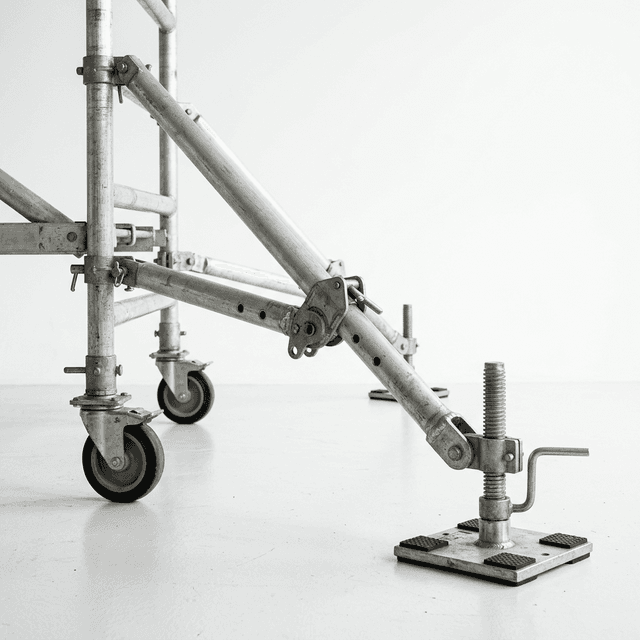
Visual cue: outriggers are system-context components
Keyword similarity does not guarantee configuration equivalence. Geometry, support, movement, and market controls must stay in the same decision path.
Major misuse risks and mitigation actions
Risks are concrete and paired with mitigation so this section can be used in procurement and safety handoff directly.
Sheeting and wind-load risk
Trigger: Adding netting, boards, or sheeting to an aluminium mobile tower without engineering approval.
Impact: Materials act as a sail, increasing lateral wind forces and potentially pushing the tower outside EN 1004-1 scope or manufacturer-approved configuration.
Mitigation: Never attach solid sheeting or netting to a standard mobile tower. Escalate to specialized engineering design if containment is required.
Sources: PASMA safety FAQ: wind guidance · PASMA EN 1004 product-standard boundary
Geometry overconfidence risk
Trigger: Team treats ratio cue as final legal approval.
Impact: Incorrect outrigger assumptions can propagate through procurement and site setup.
Mitigation: Keep checker output labeled as screening-only and require model-manual confirmation in RFQ.
Sources: HSE work-at-height FAQ · PASMA product-standard FAQ
Support-condition mismatch risk
Trigger: Brief hides edge/void/soft-fill conditions or treats them as minor noise.
Impact: Route appears commercially simple while real support risk remains unresolved.
Mitigation: Force support condition in first-pass input and escalate to manual review for edge/void states.
Sources: OSHA 1926.451 general requirements · Safe Work Australia scaffold guide
Movement-policy mismatch risk
Trigger: Buyer expects occupied movement as normal practice.
Impact: Quote path may conflict with jurisdiction controls and operational reality.
Mitigation: Mark occupied movement as hard-stop and require market-specific compliance review.
Sources: OSHA 1926.452 mobile scaffolds · OSHA mobile scaffold eTool · HSE tower scaffold safety topic
Market ambiguity risk
Trigger: Destination market is omitted or uncertain in a higher-build inquiry.
Impact: Regulatory divergence causes late-stage rework and approval delays.
Mitigation: Require market declaration and include market note in all non-routine RFQs.
Sources: HSE tower scaffold safety topic · OSHA 1926.452 mobile scaffolds · Safe Work Australia scaffold guide
Retrofit compatibility risk
Trigger: Existing tower details are incomplete but procurement requests immediate outrigger quote.
Impact: High chance of ordering incompatible components and creating schedule delays.
Mitigation: Use controlled route with model verification and compatibility confirmation checklist.
Sources: OSHA 1926.451 general requirements · PASMA product-standard FAQ
Evidence-traceability risk
Trigger: Decision notes are separated from source references and review dates.
Impact: Auditability drops and internal sign-off confidence weakens.
Mitigation: Keep source map with checked date and map each key conclusion to referenced evidence.
Sources: HSE tower scaffold safety topic · OSHA 1926.451 general requirements · OSHA 1926.452 mobile scaffolds · Safe Work Australia scaffold guide
Jurisdiction transfer risk
Trigger: Procurement copies one market rule set (for example U.S. occupied movement conditions) into a different jurisdiction.
Impact: Method statements and purchase decisions diverge from local expectations, causing late rejection and schedule loss.
Mitigation: Add jurisdiction split table output to first RFQ packet and require destination confirmation before release.
Sources: OSHA 1926.452 mobile scaffolds · HSE tower scaffold safety topic · Safe Work Australia tower/mobile scaffold info sheet
Standard-version drift risk
Trigger: Team reuses legacy EN 1004/EN 1298 references from old project templates.
Impact: Outrigger assumptions can be approved on superseded standards, weakening audit quality.
Mitigation: Gate non-routine RFQs with a current-standard check and explicit manual version reference.
Sources: PASMA product-standard FAQ
Scenario A: indoor maintenance tower refresh
Assumption: Double-width tower, 4.2 m platform, 1.45 m base width, level hardstand, occasional empty movement.
Outcome: Checker usually returns RFQ-ready with manual-confirmation note attached to first inquiry.
Caution: Do not drop model schedule checks even when the path looks routine.
Scenario B: retrofit on mixed conditions
Assumption: Single-width tower retrofit, 6.0 m platform, minor slope, frequent empty movement, outdoor sheltered.
Outcome: Checker routes to controlled review and asks for geometry + movement notes in RFQ.
Caution: Skipping control notes often creates procurement back-and-forth and delayed approvals.
Scenario C: exposed outdoor project with unclear market
Assumption: Platform build near 7.0 m with exposed outdoor condition and uncertain jurisdiction.
Outcome: Checker moves to controlled/manual boundary pending market confirmation.
Caution: Do not issue a broad “standard outriggers” quote before jurisdiction is clear.
Scenario D: edge-condition + ridden movement expectation
Assumption: Support near edge/void and team expects occupied movement during repositioning.
Outcome: Immediate manual-review route with compliance-first escalation.
Caution: Any routine quote flow here would understate risk and likely fail operational review.
Scenario E: cross-border tender with mixed rule assumptions
Assumption: Template references U.S. occupied movement controls while delivery site follows UK/AU no-rider movement baseline.
Outcome: Route escalates to controlled/manual until destination rule set and current standard references are aligned.
Caution: Do not issue a universal method statement; split by jurisdiction before commercial release.
Decision questions before sending an outrigger RFQ
FAQ keeps alias intent explicit while clarifying boundary and action quality.
Use this draft to send geometry, movement, and market context in one message.
“Aluminum scaffolding outriggers” maps to this canonical page
This U.S.-spelled alias and the UK-spelled “aluminium scaffold outriggers” variant do not create separate routes. Both resolve to `/scaffold-outriggers` and can jump directly to the checker or evidence anchors below.
Internal-link anchor examples for editors
Use aluminum scaffolding outriggers tool or aluminum scaffolding outriggers evidence summary to keep link intent on the canonical URL.
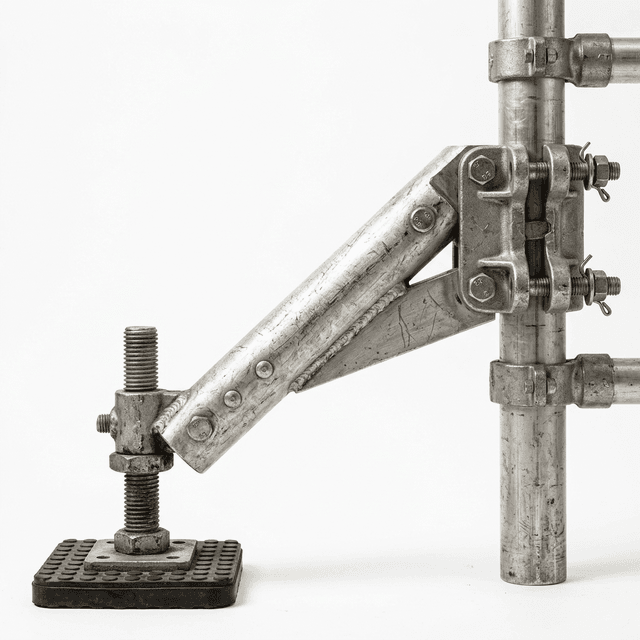
Page history
Published Apr 18, 2026. Last reviewed Jun 28, 2026. Source map refreshed on Jun 28, 2026.