Use one page to run the tool, read the evidence, and decide your next RFQ step. This canonical page covers both stair access tower and aluminium stair access towers intent without splitting traffic into duplicate routes.
This checker is built for stair access tower and aluminium stair access towers buying briefs. It outputs a route, confidence level, boundary, and next step in one pass.
Empty state: run the checker to get a stair-access route, boundary, and next action.
These are the decision points most teams need before moving from keyword intent to procurement action.
0-8 m outdoor / 0-12 m indoor
PASMA product-standard guidance cites EN 1004-1:2020 operating bands for standard mobile towers; stair-route briefs outside these public ranges need manual review.
Top rail >=950 mm, gap <=470 mm
The Work at Height Regulations 2005 (Schedule 2) sets edge-protection dimensions; if your stair path cannot physically maintain this, stop automatic routing.
Inspect before use, then at <=7-day intervals
HSE scaffolding guidance states inspection after installation and then at least every seven days where falls over 2 m are possible.
Platform fall >4 m requires HRW licence
Safe Work Australia guidance highlights licensing and control escalation when a person or object could fall more than 4 m.
Support own weight + at least 4x intended load
OSHA 29 CFR 1926.451(a)(1) requires minimum load capacity multipliers, so stair-access quote decisions must include load assumptions early.
2:1 ratio + surface within 3 degrees
OSHA mobile scaffold text allows occupied movement only under strict constraints; it is not the default assumption for stair-access procurement.
COC trigger at >=5 m; 3:1 rule above 2 m
WorkSafe NZ states a Certificate of Competence is required when any scaffold part is 5 m or more above ground, and references a 3:1 height-to-base ratio over 2 m.
13 source groups rechecked
The evidence layer lists regulator texts, standards context, and market references with explicit date markers to avoid undocumented assumptions.
One canonical URL for cluster
This page is the single canonical route for stair-access wording variants including “aluminium stair access towers”.
This round adds clause-level thresholds, failure-pattern counterexamples, and explicit known-unknown markers so decisions are auditable instead of inferred.
Keep use/not-use boundaries explicit to avoid false certainty in stair-access tower quotes.
| Scenario | Fit | Decision rationale |
|---|---|---|
| Standard stair maintenance with known geometry and moderate load | Use | Tool output is usually actionable when height basis, landing count, and market are all confirmed. |
| Public egress or continuous traffic route | Do not use directly | Requires specialist staircase-system design review and occupancy controls before quote lock-in. |
| Outdoor stairwell with wind exposure and heavy transfer tasks | Use with review | Route can be shortlisted, but stabilizer and weather controls must be reviewed from manual and local rules. |
| Unclear whether buyer means platform height or working height | Do not use directly | Height-basis ambiguity can misclassify family and risk profile at first step. |
| Narrow stairwell retrofit with repeated shift access | Use with review | Likely staircase-tower route but clearance geometry and material handoff constraints remain mandatory checks. |
| Procurement team needs fast pre-RFQ direction this week | Use | Tool gives route + boundary + CTA quickly, then report layer provides controls before final signoff. |
The report layer documents how route outputs are generated and what evidence limits still remain.
Capture measurable inputs first: working height, landing count, stair layout, load intent, and destination market.
Run the selector to classify route confidence (supported / watch / manual) before any price comparison.
Apply jurisdiction split: UK/EN, AU, US, and other markets are not merged into one pseudo-rule.
Review boundary text beside the result to identify invalid, out-of-band, or specialist conditions.
Use the comparison and risk tables to stress-test route choice against speed, compliance load, and misuse risk.
Move to inquiry CTA only after assumptions are explicit in the RFQ body.
| Jurisdiction | Trigger | Requirement | Applicability boundary | Evidence date |
|---|---|---|---|---|
| UK (WAHR + HSE) | Working platform used at height where a person could fall. | Top guard rail >=950 mm with intermediate protection so no gap exceeds 470 mm; inspect after installation and at <=7-day intervals. | Defines minimum edge protection and inspection cadence, but does not auto-approve stair geometry fit. | WAHR 2005 + HSE guidance, checked May 8, 2026 |
| US (OSHA 1926.451) | Any scaffold under construction work standard coverage. | Scaffold and components must support own weight plus at least 4x maximum intended load. | Capacity baseline only. Route selection still needs stair layout and operating-condition checks. | 29 CFR 1926.451(a)(1), checked May 8, 2026 |
| US (OSHA 1926.452 mobile) | Attempting to move a mobile scaffold while occupied. | Occupied movement is an exception gate with conditions such as <=3-degree surface and 2:1 height-to-base ratio during movement. | Treat as narrow exception logic, not routine movement permission. | 29 CFR 1926.452(w)(6), checked May 8, 2026 |
| Australia (model WHS framing) | Scaffolding work where a person or object could fall more than 4 m. | High-risk work licence is required; licence scope is split across basic/intermediate/advanced classes. | Threshold and class split help route risk, but state/territory regulator interpretation still controls final enforcement. | SWA topic + licence class pages, checked May 8, 2026 |
| New Zealand (WorkSafe) | Scaffold where any part is 5 m or more above ground. | Certificate of Competence is required; mobile scaffolds above 2 m reference a 3:1 height-to-base ratio. | Useful for competence and stability screening, not a substitute for project-specific engineering controls. | WorkSafe NZ scaffolding page, checked May 8, 2026 |
These rows are decision boundaries, not full legal advice. Always confirm the latest local regulator interpretation before deployment.
| Source | Key date | How it is used | Link |
|---|---|---|---|
| HSE tower scaffolds guidance | Checked May 8, 2026 | Used for tower movement, inspection cadence, and control-language boundaries for construction use. | Source |
| HSE scaffolding information page | Checked May 8, 2026 | Used for scaffold geometry context including guardrail and platform control references. | Source |
| PASMA product standards FAQ | EN 1004-1:2020 context; checked May 8, 2026 | Used for EN 1004-1:2020 public operating-band context for standard mobile towers. | Source |
| Work at Height Regulations 2005 (UK legislation PDF) | UK SI 2005/735 in force; checked May 8, 2026 | Used for explicit edge-protection dimensions (top guard rail height and maximum gap constraints). | Source |
| Safe Work Australia tower/mobile scaffold information sheet | Information sheet (March 2017), checked May 8, 2026 | Used for Australian thresholds and control signals in tower/mobile scaffold conditions. | Source |
| Safe Work Australia scaffolding topic page | Checked May 8, 2026 | Used for licensing trigger framing, SWMS/high-risk construction reminders, and regulator role boundaries. | Source |
| Safe Work Australia high-risk work licence classes | Model WHS framework; checked May 8, 2026 | Used for AU licence class split (basic / intermediate / advanced) and scope boundaries. | Source |
| Safe Work Australia code of practice: falls at workplaces | Model Code of Practice update 2022; checked May 8, 2026 | Used for threshold logic (fall >4 m licensing trigger) and mobile scaffold setup limits. | Source |
| OSHA 1926.451 scaffold general requirements | Current OSHA text checked May 8, 2026 | Used for U.S. control baselines including inspection and power-line related limits. | Source |
| OSHA 1926.452 mobile scaffolds | Current OSHA text checked May 8, 2026 | Used for U.S. movement-specific constraints and occupied-movement exception framing. | Source |
| WorkSafe New Zealand scaffolding guidance | Checked May 8, 2026 | Used for NZ movement and clearance boundaries that frequently impact stair access planning. | Source |
| Safe Work Australia guide to scaffolds and scaffolding | Guide rechecked May 8, 2026 | Used for material handling boundaries, including the warning not to mix steel and aluminium tubes in one scaffold. | Source |
| BoSS Staircase Tower product page | Product page checked May 8, 2026 | Used as product-level evidence that staircase towers are treated as dedicated systems in practice. | Source |
Source log rechecked on May 8, 2026. If a region-specific legal interpretation is not explicitly published in these references, this page labels it as manual confirmation required. Unresolved data items are listed in the evidence-gap section below.
These patterns are common reasons teams misroute stair-access briefs even when a quick checker result exists.
| Common assumption | Why it fails | Safer alternative | Evidence anchor |
|---|---|---|---|
| “It is aluminium, so safety and compliance risk must be lower by default.” | Material does not resolve stair geometry, guardrail fit, or movement rules, and Australian guidance warns against mixing steel and aluminium tubes in one scaffold. | Decide route by geometry + usage + market first, then use material as a secondary filter. | SWA scaffolds guide + HSE/OSHA controls (checked May 8, 2026) |
| “OSHA allows occupied movement, so moving while someone is on the scaffold is usually acceptable.” | OSHA frames occupied movement as a condition-heavy exception with slope and stability limits. | Default to no occupied movement unless every exception condition is explicitly documented. | OSHA 1926.452(w)(6), checked May 8, 2026 |
| “Height is under 12 m indoors, so the stair route is automatically compliant everywhere.” | EN 1004 operating bands are product-standard context; legal duties and inspection cadence still differ by market. | Use EN 1004 only as first-pass screening, then apply jurisdiction-specific controls before RFQ release. | PASMA EN 1004 FAQ + UK/US/AU regulator texts (checked May 8, 2026) |
| “Urgent public-access staircase work can be treated as a normal maintenance brief.” | Public-egress and high-traffic conditions raise control complexity and are repeatedly flagged for specialist handling. | Switch to manual/specialist staircase review and keep occupancy assumptions explicit in the brief. | HSE + SWA + tool boundary model (checked May 8, 2026) |
Compare route alternatives before locking to one quote line.
| Option | Best for | Speed vs control | Compliance load | Decision trigger |
|---|---|---|---|---|
| Standard stair access tower package | Routine service access with known stair geometry | Fast shortlist speed with moderate control burden | Medium | Use when traffic is controlled and no public-egress or heavy transfer condition is present. |
| Specialist staircase tower system | Frequent climbing/descending and wider landings | Slower quote cycle but strongest control posture | High | Use when layout is complex, repeated traffic is high, or occupancy scenario is sensitive. |
| General mobile access tower fallback | Flat-ground routine tasks, non-stair-specific access | Quickest commercial cycle, highest misuse risk if forced into stair use | Low to Medium | Do not force this route when stair geometry is the core constraint. Keep it as a non-stair baseline only. |
| Podium / low-level platform alternative | Short-duration low-height interior tasks | Fast deployment but narrow capability envelope | Medium | Use when the task sits below the threshold where full stair-access tower complexity is justified. |
Height-basis mismatch (working vs platform height)
HighImpact: Wrong family selection and unstable quote assumptions.
Mitigation: Force both height definitions into the first RFQ message and keep result provisional until clarified.
Public-egress scenario treated as routine maintenance
MediumImpact: Underspecified controls for traffic and emergency-use conditions.
Mitigation: Use specialist staircase-system review path with explicit occupancy assumptions.
Cross-market rule mixing (UK/AU/US blended into one rule)
MediumImpact: Legal and inspection steps may be missed in final deployment market.
Mitigation: Apply one market frame per job and list unresolved legal checks before PO release.
Urgent timeline suppresses manual geometry checks
HighImpact: Fast quote may hide stairwell pinch-point failures or landing constraints.
Mitigation: Use watch/manual output as a stop signal and escalate geometry evidence in same cycle.
Over-trust in material keyword (“aluminium”) as safety proof
MediumImpact: Material choice is mistaken for route suitability and compliance readiness.
Mitigation: Keep material as secondary filter; decide route first by geometry and usage conditions.
Where open evidence is insufficient, this page does not force a hard conclusion. It marks the gap and keeps next actions explicit.
| Decision question | Current status | Impact on decision | Minimum next step |
|---|---|---|---|
| What is the regulator-published incident rate specifically for stair-access towers? | No reliable public dataset was found in this pass that isolates stair-access tower incidents as a separate subtype. | Risk ranking cannot be converted into a statistically calibrated failure probability. | Treat current matrix as qualitative routing aid and request contractor/regulator incident logs during procurement. |
| What is the public benchmark for total installed cost by stair geometry class? | No high-confidence open dataset with consistent geometry taxonomy was identified. | Speed-vs-control tradeoff cannot be reduced to one universal cost curve. | Collect supplier quotes using the same geometry template and compare internally before lock-in. |
| Can cross-jurisdiction inspection acceptance be assumed (UK to AU/US/NZ)? | No primary source in this set states universal cross-market equivalence. | Reusing one inspection artifact across markets may create approval gaps. | Require destination-market validation even when design appears similar. |
Example paths show how assumptions, route output, and outcomes stay connected.
Assumption: 6.5 m working height, 2 landings, narrow stairwell, tool transfer.
Route: Watch -> staircase tower shortlist + geometry review.
Outcome: Team avoids forcing a general mobile tower and captures layout checks before RFQ submission.
Assumption: 8 m, public egress, continuous access expectation.
Route: Manual -> specialist stair-system review path.
Outcome: Quote stays on controlled path instead of producing false quick approval.
Assumption: 5 m, single flight, occasional access, inspection-light load.
Route: Supported -> standard stair-access package with documented assumptions.
Outcome: Buyer receives fast next step and remains aware of boundary conditions.
Assumption: 9 m, switchback layout, mixed environment, urgent 48h timeline.
Route: Watch -> provisional route with mandatory manual checks.
Outcome: Delivery speed is preserved while keeping stabilizer and weather controls explicit.
Decision-focused answers for recurring stair-access and aluminium stair access towers questions.
Include the checker route, confidence, and boundary statement in your inquiry so review teams can verify controls quickly.
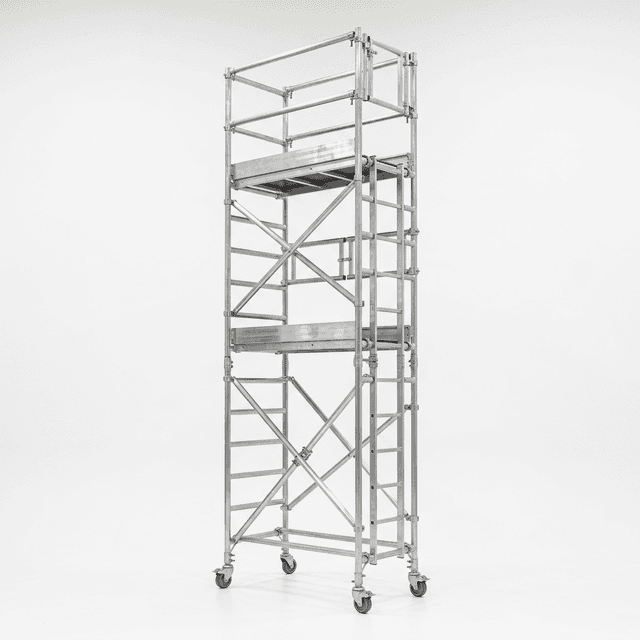
Send your stair access tower brief with tool output and boundary notes.
Internal routing anchors
Related navigation keywords route to this canonical page:
This page provides decision support, not engineering certification or legal advice. Always confirm final controls against current local obligations and the exact system manual.
Canonical coverage checkpoint
Need the broader access-tower context? Continue with the related canonical page while keeping stair-specific route decisions here.